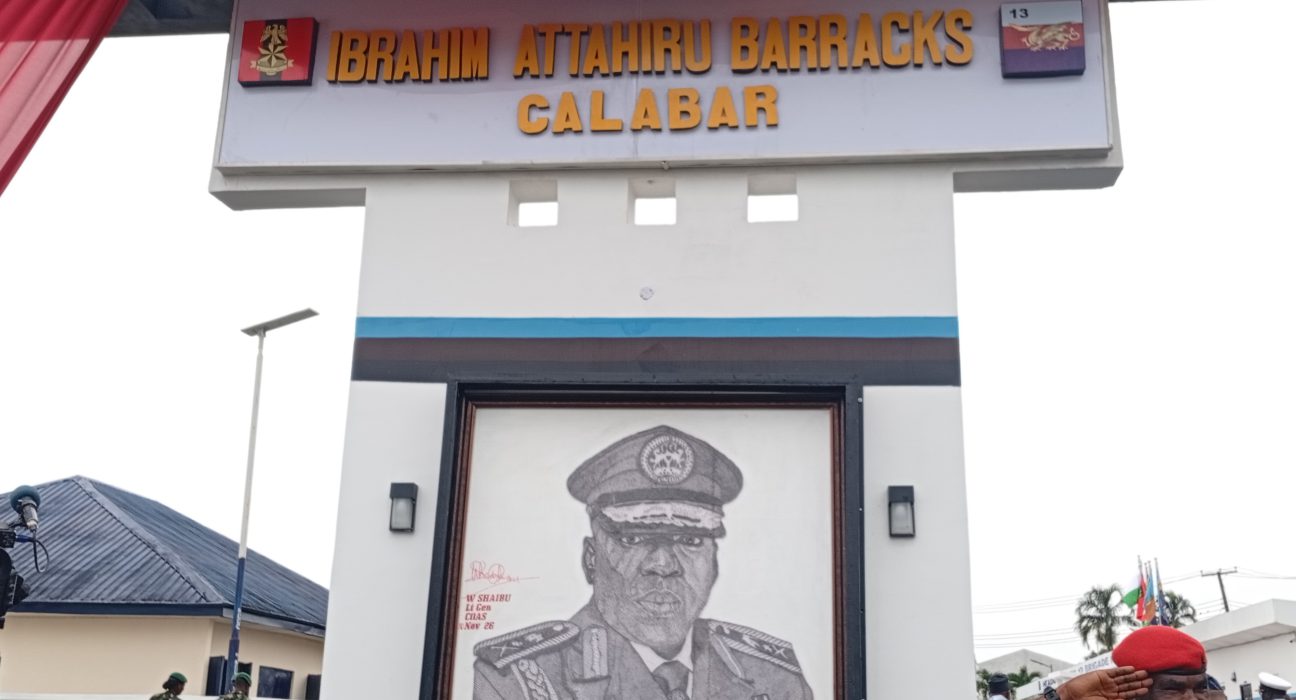
By Patrick Obia
Lieutenant General Ibrahim Attahiru served as Nigeria’s Chief of Army Staff from 26th January to 21st May 2021. A tenure of just 114 days.
He died in an air crash alongside 10 other officers and men of the Nigerian Armed Forces. Cutting short a distinguished 35-year military career that had taken him through nearly every rank of command in the Nigerian Army. Born on 10 August 1966 in Kaduna Local Government Area of Kaduna State.
Lieutenant General Attahiru was admitted into the Nigerian Defence Academy as a member of the 35th Regular Course in 1984 and was commissioned into the Infantry Corps of the Nigerian Army as a second Lieutenant in December 1986.
General Attahiru’s early career took him beyond Nigeria’s borders. He served with the United Nations in Sierra Leone as a military observer where he facilitated the United Kingdom’s military engagement Operation in September 2000.
He later served in Liberia as an operations officer and subsequently Company Commander in Nigerian Battalion 19 of the Economic Committee of West African States Monitoring Group Mission (ECOMOG).
Among the many commands General Attahiru held, his tenure as the Commander of 13th Brigade Nigerian Army stands out as one of the most consequential.
Leading the Brigade’s forces under the X-1 Operation Polo Shield, he oversaw operations aimed at securing the Niger Delta and protecting Nigeria’s oil and gas assets from militancy, illegal bombing and pipeline vandalism. A mandate that placed the Brigade at the center of one of Nigeria’s most strategically sensitive theaters.
Beyond operations, General Attahiru left a lasting institutional legacy at 13th Brigade.
He conceived and executed several infrastructural projects during his command, notably among them is the 13th Brigade Fitness Center, which has since been renamed in his honor in recognition of his contribution to troops’ welfare and readiness.
He also renovated Lugard House, one of the oldest structures in Nigeria, and a heritage building within the Brigade, preserving a piece of the nation’s colonial and military history for future generations. This combination of operational command in a high-stakes theater and deliberate investment in infrastructure and heritage reflected a leadership style that balanced immediate security demands with a long-term welfare and institutional memory of the men and women under his command.
Late General Attahiru’s ranks
General Ibrahim Attahiru had the rare privilege of commanding with distinction at every level of the chain of command. He served as Commanding Officer of 146th Battalion Nigerian Army during the S-12 Operation Harmony 4 in the Bakassi Peninsula, and later as General Officer, commanding 82th Division Nigerian Army.
He also served as Theater Commander of Operation Lafiya Dole, the counter-terrorism and counter-insurgency operation in north-eastern Nigeria, where his leadership contributed to relative stability in the region and the surrender of several Boko Haram combatants.
His Appointments
His staff appointments included Unit Adjutant of 7th Battalion Nigerian Army 30 and Chief of Staff of 1 Brigade Nigerian Army Sokoto.
He served as General Staff Officer Grade 1 for training and operations, and separately for staff duties and plans at Headquarters 1, 2, and 81 Divisions of the Nigerian Army. He later served as Deputy Director, Military Secretary II at Army Headquarters Military Secretary Department, and as Director of Army Public Relations and Spokesperson of the Nigerian Army.
He went on to serve as Director of Staff Duties and Deputy Chief of Policy and Plans at Army Headquarters.
At the Defense Headquarters in Abuja, the apex organ of Nigeria’s Armed Forces, he served as Chief of Defense Transformation and Innovation, and later he served as Chief of Logistics. In the latter role, he worked with the United States Defense Logistics Agency on the Vertically Integrated Logistics Approach Program, aimed at enhancing the operational readiness of the Armed Forces of Nigeria. General Akairu also shaped the next generation of officers as an instructor.
He taught at Tepo Nigerian Army, the Nigerian Defense Academy, and the Nigerian Army School of Infantry, and later served as Director, Staff, and Chief Instructor at the Armed Forces Command and Staff College. Professional Development.
Ibrahim Attahiru attended leadership and professional development programs at several globally renowned institutions. These included the National Defense College, Kenya, for the National Defense Management and Security Studies course, and the Chinese People’s Liberation Army Special Forces Academy in Shijian Zone, Hubei Province, China, for the Basic and Advanced Special Operations Commando Forces courses.
He also completed leadership and security policy courses at the Kennedy School of Government, Harvard University in the United States, the Graduate School of Media and Communication at Aga Khan University in Kenya, the Bournemouth University Disaster Management Center, and the Geneva Center for Security Policy.
General Akairu held two Masters of Science degrees, one in Strategic Management and Policy Studies from the Nigerian Defense Academy, and another in Human Resources Management and Development from Salford University in the United Kingdom. He also held a Graduate Diploma in International Studies from the University of Nairobi, Kenya.
His Honors and Awards
Late Gen. Ibrahim Attahiru was decorated with the United Nations Mission to Syria Human Medal, the ECOMOC Medal, the Forces Service Star, the Meritorious Service Star, the Distinguished Service Star, the Ground Service Star, the Core Medal of Honor, and the Command Medal, the Field Command Medal, and the Field Command Medal of Honor.
His Legacy
From the creek of the Niger Delta to the frontlines of counterinsurgencies campaigns in the Northeast, and from the lecture halls of Jersey to the corridors of Army and Defense Headquarters, his career was one of consistent, distinguished service. His command of 13th Brigade in particular remains a lasting example of leadership that secured territory while also building institutions and preserving heritage for those who came after him.
Short Link:
Leave feedback about this