
By Ogar Monday
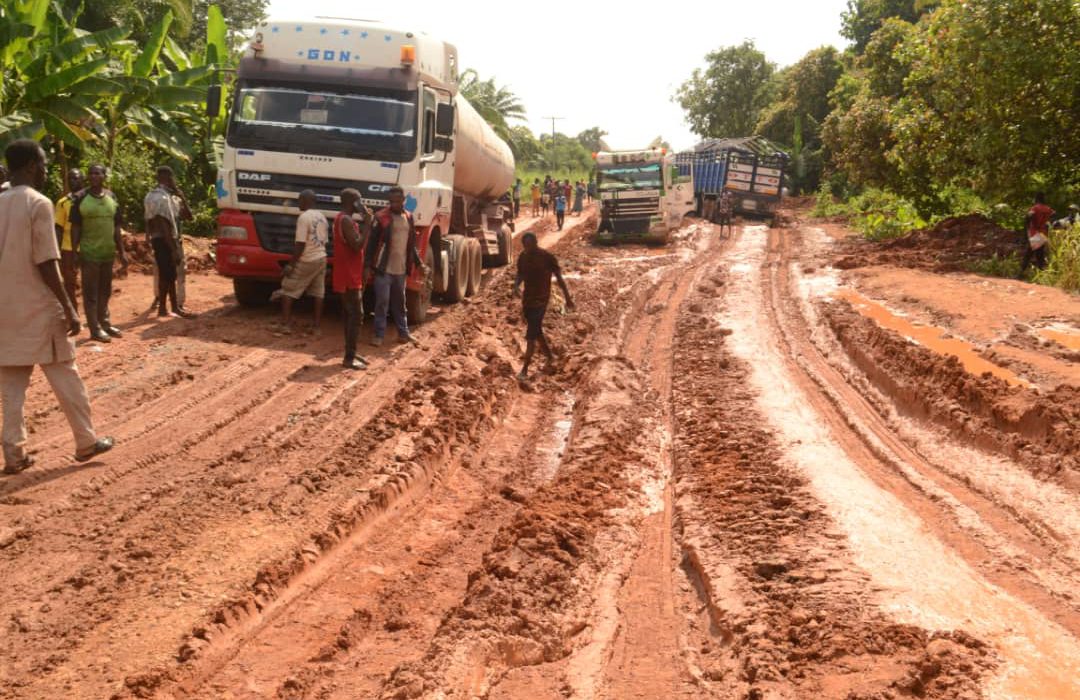
The truck lurches violently as its front wheels slam into yet another crater on Ogbuma Junction section of the Ogoja–Katsina Ala road. Inside, Musa Adamu grips the dashboard as the load of yams he is moving to Abakaliki in Ebonyi State, shifts dangerously. He’s been on this road for fifteen years, but the past year has been some of the worst he’s ever seen.
“Look at this,” he says, gesturing at the windshield as another truck tries to crawl past the section where his truck just passed. The asphalt on this part of the road has completely disintegrated, leaving jagged rocks and red earth, and holes at least two feet deep. “This is supposed to be a federal highway o. Is this how goods and food are supposed to move within a country?” he asked rhetorically.
What Adamu might not be aware of is that on paper, this road should have been fixed. In August 2024, the Federal Government of Nigeria paid five hundred and fifty-six million Naira (₦556,000,000) to Dylancia Concept/Solution Nig. Ltd and Emma Ventures Investment Ltd to fix the road, but more than a year after the money was released, the road looks exactly the same, barely motorable. Communities along the 186-kilometer corridor say there are no contractors on-site, no machines, not even a project signboard, and they have been left to deal with the accidents and all the troubles that come with the bad roads.
The Road Nigeria Cannot Afford To Lose
The Ogoja–Katsina Ala–Jalingo Road is an economic artery connecting Nigeria’s food basket to the south of Nigeria. The road also serves trucks moving petroleum products from fuel depots in Calabar, Cross River State, to the North-East and some parts of the North-central. Between 2023 and 2024, average transport costs on the route have increased by at least 87 percent, according to interviews with several drivers in Ogoja, Vandekya, and Katsina-Ala. What used to cost ₦80,000 to move a 20-ton truckload of yams from Zaki-biam to Ogoja now costs ₦150,000, and sometimes more, depending on how many times a vehicle breaks down.
Musa Adamu, the yam trader who has used the route for fifteen years, says business has never been worse. “We spend more money repairing our vehicles than making profit,” he says, standing beside his truck at a fuel station in Katsina-Ala. “A four-hour trip now takes eight or ten hours. By the time we arrive, half of the yams are already damaged from the constant shaking and the heat.”
Transporters report similar patterns. Samuel Oche, a driver, said sometimes drivers abandon the corridor entirely. “They’re taking longer routes through Makurdi, the capital of Benue State, or even through Gboko,” he says. “Those routes waste fuel, but at least the vehicles survive.”
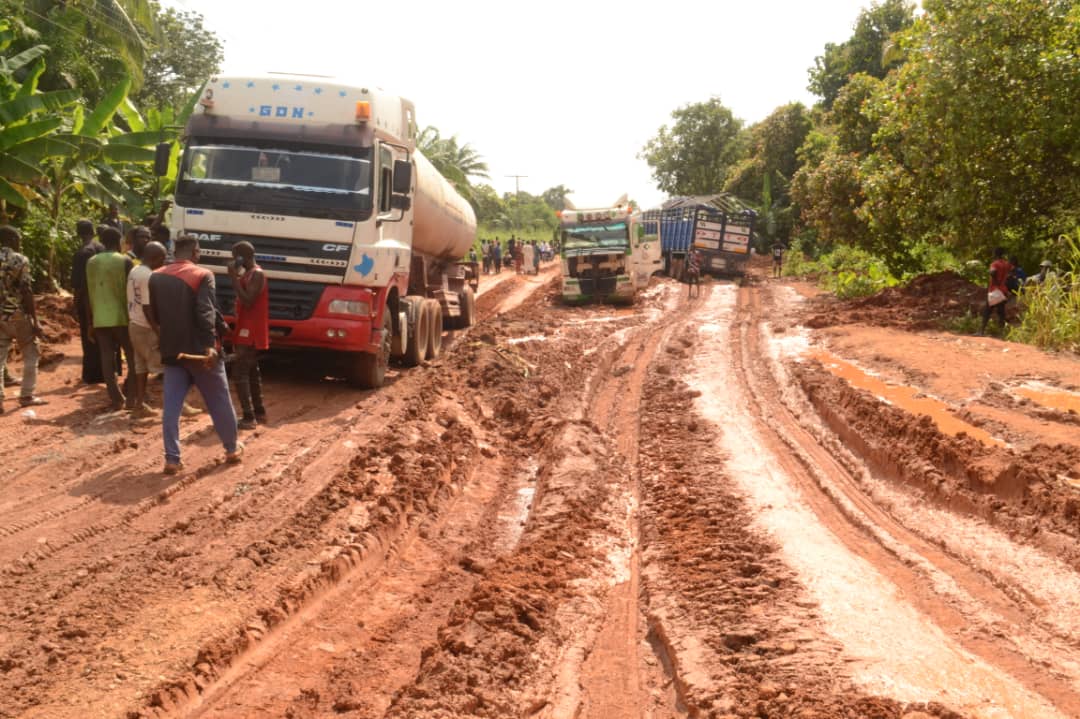
The abandonment of the direct route has created a secondary crisis: fuel waste and increased carbon emissions. A truck traveling from Katsina-Ala to Calabar via the direct Ogoja route covers approximately 186 kilometers. The alternative route through Makurdi adds an extra 134 kilometers, increasing fuel consumption by an estimated 45 percent per trip.
“People think it’s just inflation, but half of what you’re paying is because the road is bad,” says Comfort Nwosu, a yam seller who buys yams in Zaki Biam and sells them in Oil Mill Market in Rivers State. “The drivers are not cheating us. Their vehicles are being destroyed. Someone has to pay for it, and it’s the final consumer.”
Following The Money

Data from Tracka, an open treasury portal, reveals that between August and October 2024, the Ministry of Works disbursed ₦556 million for the rehabilitation of the Ogoja–Katsina Ala–Zaki Biam stretch up to the Taraba border. Both contractors were expected to mobilize to the site immediately.
According to the project scope, the rehabilitation work was intended to include clearing drainage channels, repairing culverts, patching potholes, grading uneven sections, and laying asphalt on the most critically damaged stretches.
However, CrossRiverWatch’s field verification conducted in November 2025 across Ogoja and Katsina-Ala showed no signs of activity. Not a single culvert had been touched. No drainage cleared. No portion of the road was scraped or graded. Not one meter of asphalt was laid by either company.
Local sources say they were never contacted. “We are only hearing about this now,” says Terver Ihugh, who loads vehicles in Branch, Vandekya, Benue State. “No contractor has come here to introduce themselves. There is nothing on the ground: no workers, no equipment, nothing. It’s as if the project doesn’t exist.”
Attempts to reach the two companies were largely unsuccessful. Physical address associated with Dylancia Concept/Solution Nig. Ltd led to a nondescript location in Shomolu, Lagos State, where building staff and neighboring tenants claimed never to have heard of the company.
Emma Ventures Investment Ltd’s address in Bauchi also does not exist.
Records confirm both companies are registered and legally recognized entities. Dylancia Concept/Solution Nig. Ltd was incorporated in 2018, while Emma Ventures Investment Ltd has been registered since 1999. But beyond these basic details, little is publicly known about their track record or previous projects.
When CrossRiverWatch repeatedly contacted the Federal Ministry of Works office in Calabar, officials said the Controller of Works, Engineer Yinka, was not in his seat. Several calls placed to his official phone number were not received.
Abdullahi Adebayor, a public finance analyst, said the economic impact of abandoned projects like the Ogoja–Katsina Ala road is felt almost immediately. “Farmers can’t move their produce to markets because the roads are impassable. Crops rot on the way or never leave the farm at all. Small businesses suffer because customers can’t reach them, and in emergencies, people struggle to access health facilities,” he explained.
Adebayor warned that abandoned projects also fuel unemployment. “One stalled project can push hundreds of people out of work in places where jobs are already scarce,” he said, drawing a link between joblessness and insecurity. “Young people with no prospects are far more vulnerable to being recruited by criminal gangs.”
He added that repeated project failures erode public trust in democracy itself. “People watch contracts being announced and groundbreaking ceremonies held. Then nothing happens. When those projects are abandoned, citizens stop seeing democracy as a tool for development and begin to see it as a system designed to enrich a few.”
Adebayor argued that part of the problem lies in how government budgets are prepared. “We need to budget based on the money we actually have,” he said. “This culture of deficit budgeting, where we approve a hundred projects knowing we can only fund twenty, is fiscally irresponsible. It’s exactly how we end up with half-finished and completely abandoned projects scattered across the country.”
He also stressed the need for stronger community involvement. “Development should be planned from the bottom up. Communities should help identify their most urgent needs and be involved from conception to completion,” he said. “When people see a project as their own road, they monitor it and demand accountability. But when projects are decided in offices in Abuja by people who have never been to these communities, nobody feels responsible when they are abandoned.”
This report was produced with support from Civic Media Lab under its Grassroot News Project (GNP).
Since You Are Here, Support Good JournalismCrossRiverWatch was founded on the ideals of deploying tech tools to report in an ethical manner, news, views and analysis with a narrative that ensures transparency in governance, a good society and an accountable democracy. Everyone appreciates good journalism but it costs a lot of money. Nonetheless, it cannot be sacrificed on the altar of news commercialization. Consider making a modest contribution to support CrossRiverWatch's journalism of credibility and integrity in order to ensure that all have continuous free access to our noble endeavor. CLICK HERE |
New Feature: Don't miss any of our news again.Get all our articles in your facebook chat box.Click the Facebook Messenger Icon below to subscribe now
Text Advert by CRWatch :Place Yours

Will You To Learn How To Make Millions Of Naira Making Special Creams From Your Kitchen?.Click Here
Expose Your Business And Make More Sales. Advertise On CrossRiverWatch.com Today
Leave feedback about this