By Sylvia Akpan
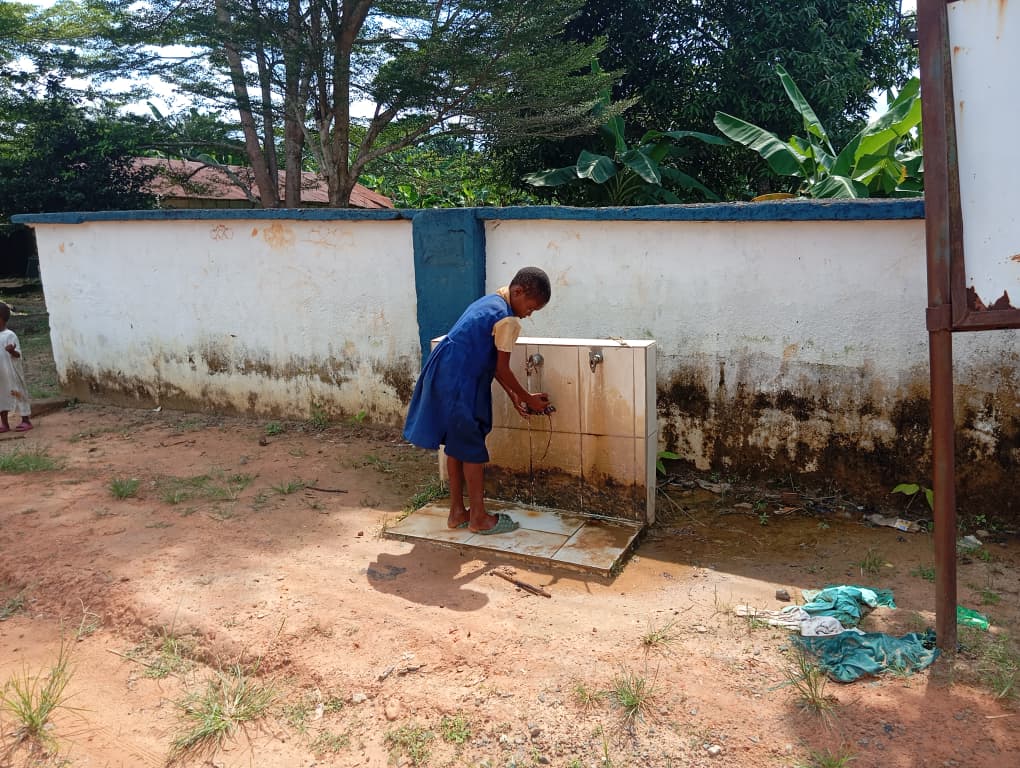
While the voices of pupils echoed across the Agwagune community, a nine-year-old girl stood at the premises of the community’s primary healthcare center, desperately trying to quench her thirst.
Dressed in her blue and orange school uniform, she wrestled with a rusty tap at Agwagune Primary Health Center in Biase Local Government Area of Cross River State, hoping to fill her container with water.
She was not there to see a nurse or accompany a sick relative, she had come to fetch drinking water. But she left disappointed without a drop.
The tap stood inside a primary healthcare facility – a place where pregnant women are expected to receive antenatal care, mothers give birth, children receive vaccinations and sick residents seek treatment.
Water, in such a place, should not be a luxury. But in this case, it was golden. It is essential to handwashing, cleaning, infection prevention, childbirth, drinking and virtually every aspect of safe healthcare delivery.
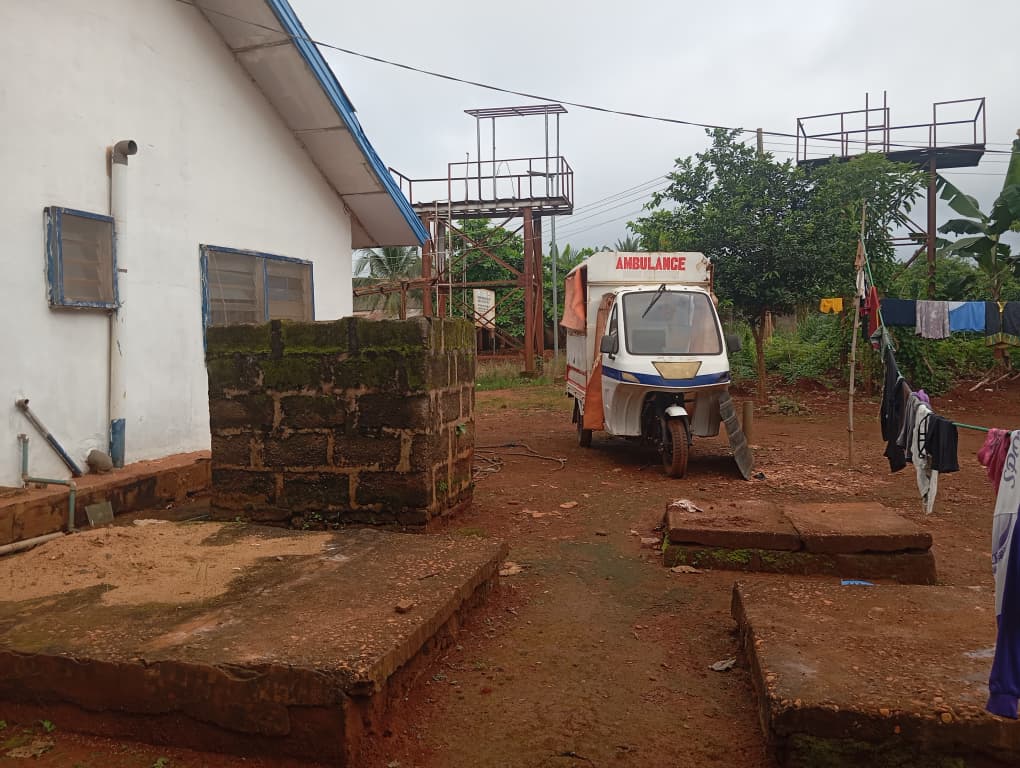
Yet above the girl, water tanks sat on the roof of the health center while their inside were as dry as the Sahara desert. The perimeter wall was stained with mould, and plastic waste lay scattered across parts of the compound.
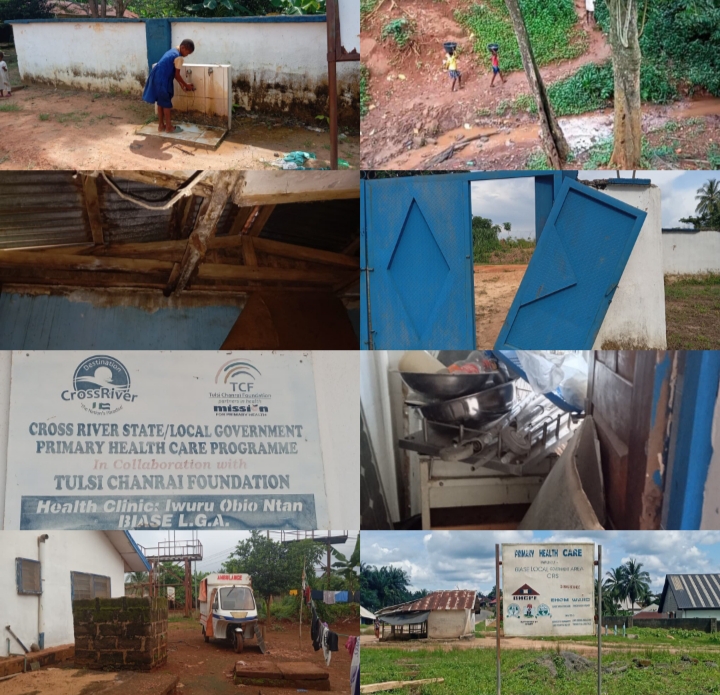
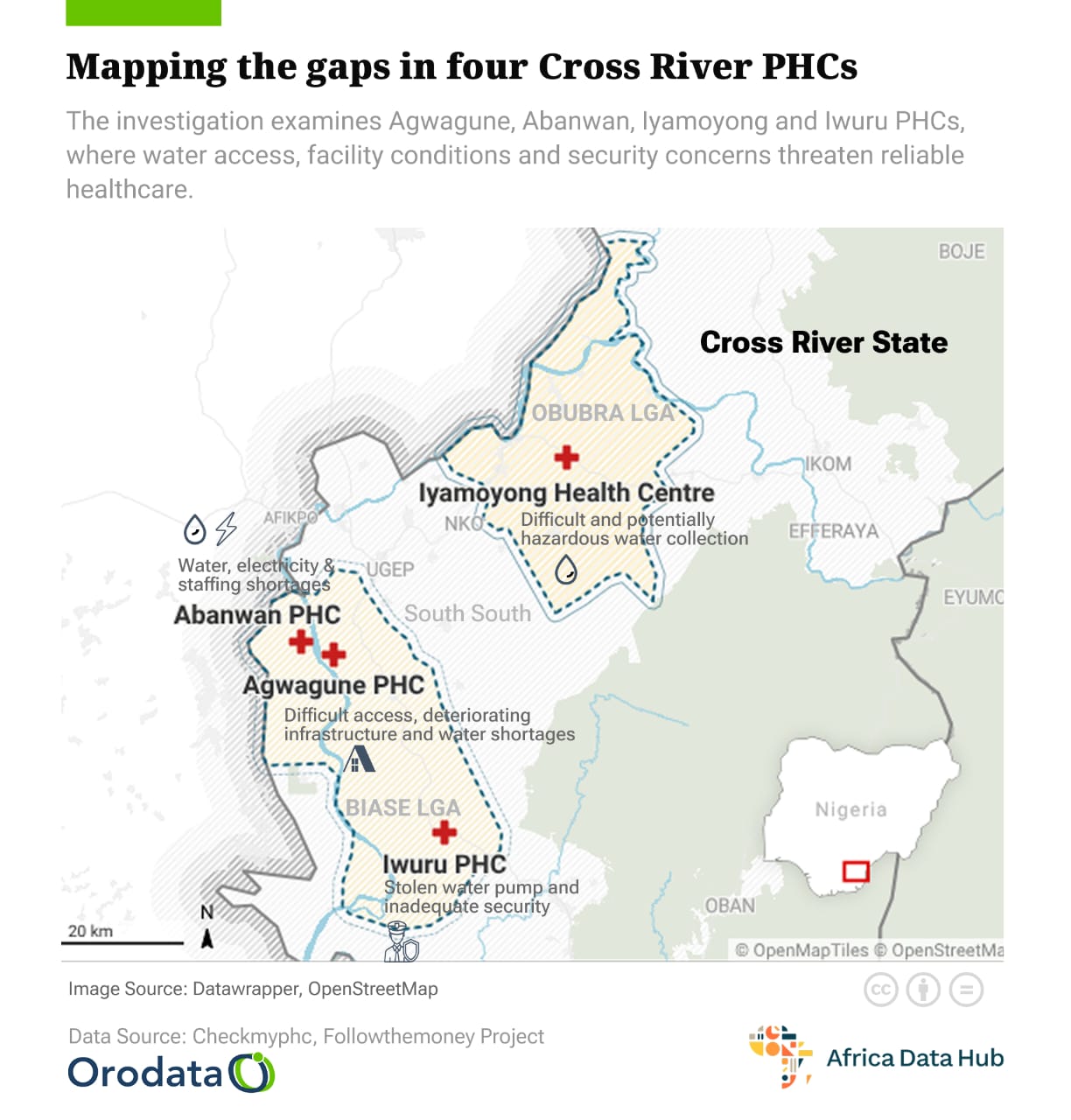
The scene at Agwagune is not an isolated one. Across several primary healthcare centers visited in Cross River State, this investigation found communities and health workers confronting a combination of water scarcity, unreliable electricity, inadequate staffing, insecurity, poor sanitation and deteriorating infrastructure.
When Water, Power And Workers Are Scarce
At Agwagune Primary Health Center, the shortages begin with some of the most basic requirements of healthcare: water, electricity and personnel.
Community Health Officer Ogban Elsie Kanu was attending to six patients when she spoke with CrossRiverWatch about the challenges confronting the facility. She said electricity remains unreliable.
“There is no NEPA (public power supply) light in the community, and the solar light is only on during the daytime. At night, there is no light,” she said, adding that the solar system doesn’t power even a fan and usually goes off before 6:00 PM. This forces staff to charge portable solar lamps during the day for emergencies, including night-time deliveries.
Water infrastructure is also in poor condition, with leaking tanks adding to the facility’s difficulties. But perhaps the greatest burden falls on the few health workers available.
Mrs. Kanu said she often works alone, attending to patients during the day while remaining on call for emergencies after she gets home.
“As you can see, I am alone here. Even if I work until 6:00 PM and get home, I can still receive a call to return, especially when there is a labor or other emergency.”
The shortage turns her to a one man squad who handles virtually everything in the facility. “We do not have a lab technician, we do not have a records officer, we do not have a pharmacist. We all do it ourselves. So we need help.” The result is a facility where one worker can find herself performing several roles at once.
Inside the health center, an examination table bore visible stains and signs of prolonged use. Sections of the ceiling had also given way, exposing wooden roof members and rusted roofing sheets. An electrical wire hung through one of the damaged sections. Each problem might appear manageable in isolation.
Together, they point to a healthcare environment where basic infrastructure is struggling to keep pace with the needs of the community.
A PHC Disappearing Into The Bush
For patients trying to reach Abanwan Primary Health Center, accessing healthcare begins with a journey.
Reaching the facility requires a speedboat ride followed by a rough motorcycle trip over stones and red laterite. For pregnant women, elderly residents and sick patients, the journey itself can become a barrier before treatment even begins.
READ ALSO: Welcome To Cross River Community Where Child Deliveries Are Done In Pathetic Collapsed Health Center
At the facility, the signboard leaned from a rusted pole while waist-high grass and vegetation surrounded the building. There was no visible perimeter fence or gate. Behind the facility, an open pit was being used to burn medical and general waste. Partially burnt pharmaceutical packaging, plastic vials and other materials were scattered around it.
The setting raises concerns not only about access but also about sanitation and the safe disposal of healthcare waste. Community Health Officer, Uwen Oyene Ogban said the facility was still dealing with the consequences of a previous crisis in which parts of the facility and equipment were destroyed.
Her words: “Some parts of the health facility, including the quarters, were affected. Some tables and other things were also burned. All our things here are no longer in order. We are just managing it to help our people around,” she said.
READ ALSO: When Caregivers Become Victims: Unsafe Sanitation In Cross River’s Primary Health Centers
She appealed for the renovation of the facility and replacement of damaged equipment. But there is another problem: too few workers. Only two workers; a Community Health Officer and a Junior Community Health Extension Worker who are currently attending to patients.
“When one is out, you remain alone in the health facility. So, we need government intervention to send more staff to us and renovate the health facility, she pleaded.
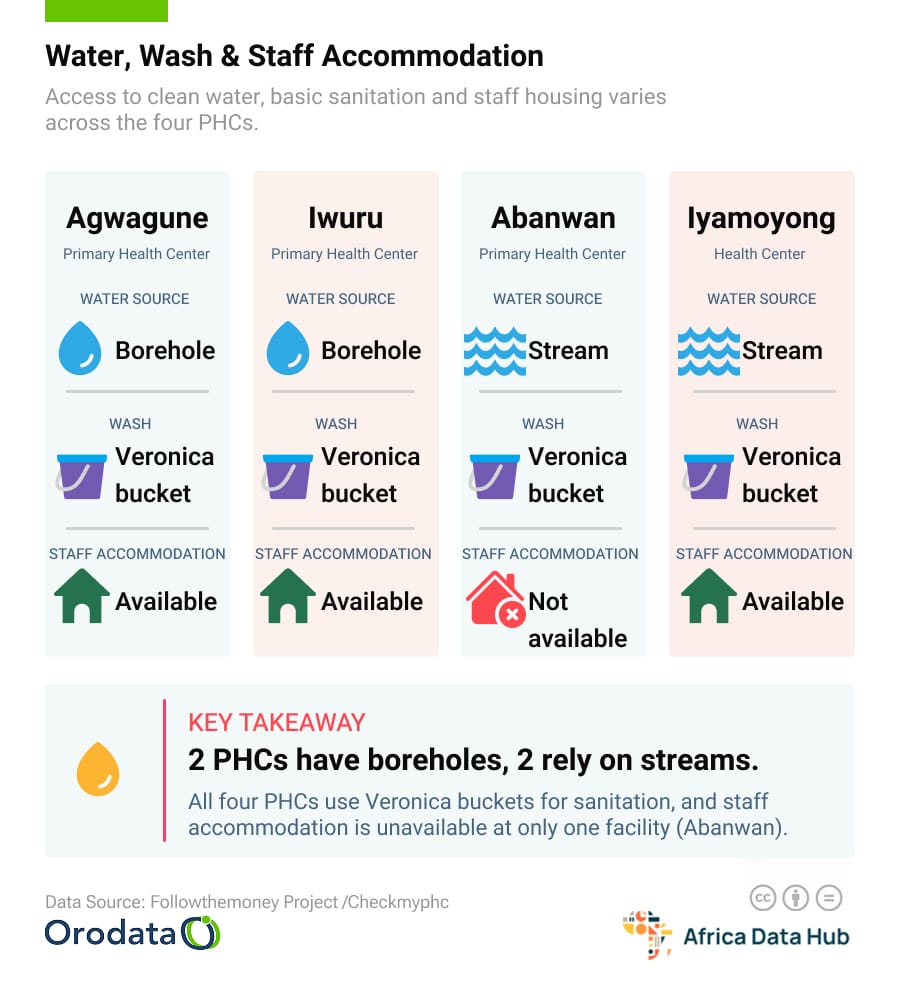
The facility has no functional water source, forcing workers to travel to a stream to fetch what they need. “We have no water. We go very far away to fetch water from a stream,” she added.
Its solar system, however, remains functional and helps preserve vaccines.
When Water Comes With A Risk
At Iyamoyong Primary Health Center, the building appears more intact than some of the other facilities visited.
But cracks, overgrown vegetation, eroded areas and deteriorating window screens point to maintenance problems.
The most immediate challenge is water. Health workers depend on a natural water source located down steep terrain. To obtain water, they must descend the slope, fill their containers and climb back up carrying the weight.
For Richard Peter, a Nutritional Assistant at the facility, the task becomes particularly difficult during the dry season. He said: “When you fall, you get up, you come back and fetch another one. But during the dry season, it becomes the worst.”
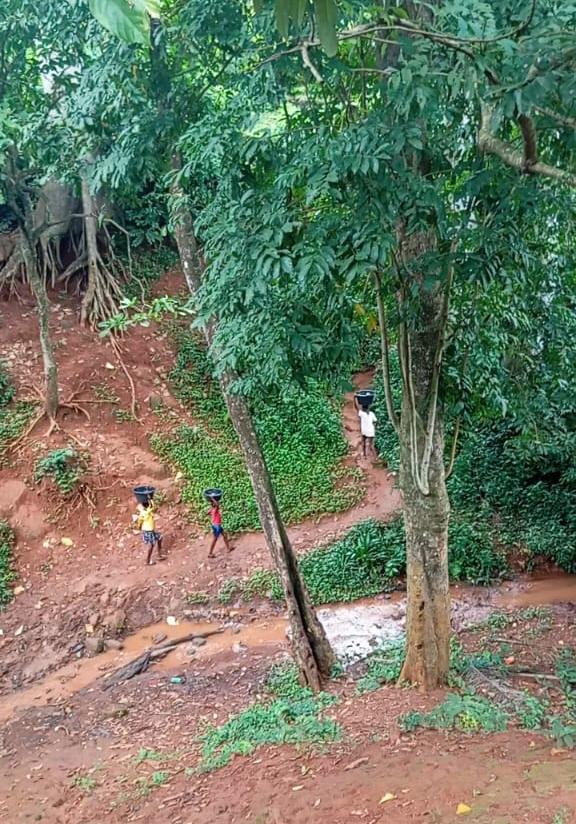
As the water source dries up, more people gather. He said the reduced flow attracts more people, creating long queues. He added: “During the dry season, you will meet traffic as more gallons will be piled up. You will have to come very early or you will wait for those that came earlier to fetch theirs before it gets to your turn.”
The physical burden is only part of the problem. Every hour spent walking down a steep slope and returning with water is time that could otherwise be spent attending to patients. “Imagine the stress of going down to get water and going up with the water to attend to patients. It is something extraordinary,” he expressed.
The World Health Organization says safe water, sanitation and hygiene in healthcare facilities are fundamental to safe, quality and people-centered healthcare and to protecting the dignity of patients and health workers. For a healthcare facility, water is needed for drinking, cleaning, hand hygiene, sterilization, patient care, childbirth and infection prevention. Its absence can therefore affect far more than convenience.
When Insecurity Steals The Water
At Iwuru Primary Health Center, the water crisis is directly linked to insecurity. The facility’s water pump was reportedly stolen after burglars broke into the premises, leaving the center without a reliable water source. Officer-in-Charge, Ujima Mba Otu said the absence of a perimeter fence contributed to the incident.
“One of the challenges is that we are not secured because there is no fence around the facility. That led to burglars breaking in and vandalizing the SUMO, which is why we currently lack water supply.”
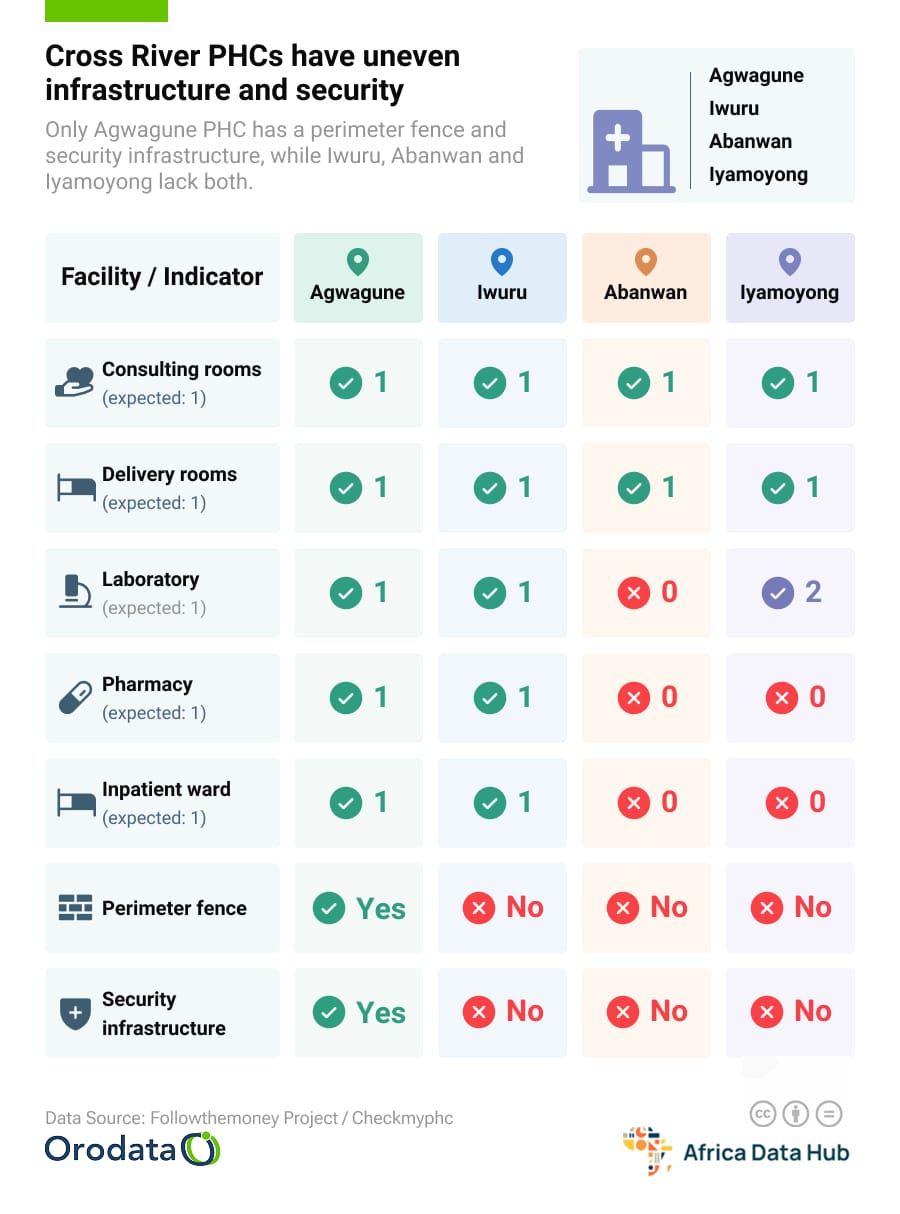
While the facility struggles with water public power supply is also a struggle. Officer Ujima added: “We don’t have solar. The panels here are just for show. We don’t have solar lights, we don’t have electricity, and we manage with a generator.”
At night, workers depend on torchlights. For Mrs. Otu, all the workers at the facility are female, the lack of security creates an additional layer of fear. “You cannot even stay around here at night because you see people trooping in. At night, you don’t sleep. Somebody can just come and sit by our door and make noise. The place is not secured, and we are all female.”
The staffing situation adds to the pressure. Otu said she is the only salaried government employee at the facility, while other trained health workers work as volunteers. She however appealed for the volunteers to be employed, the facility fenced and its power supply restored.
Where Is The Money Going
The conditions documented at these facilities raise questions about how public investment in primary healthcare reaches the grassroots. The Basic Health Care Provision Fund (BHCPF) was established to strengthen primary healthcare and support essential services at the community level.
READ MORE: How Bad Roads To Cross River Primary Healthcare Leads To Miscarriages, Death
On October 22, 2025, Nigeria’s Federal Ministry of Health and Social Welfare announced the approval of ₦32.9 billion for disbursement under a revised BHCPF framework intended to improve primary healthcare access and accountability.
For communities such as Agwagune, Abanwan, Iyamoyong and Iwuru, the important question is what portion of public healthcare funding eventually translates into functioning infrastructure and services.
If water infrastructure is installed, who ensures that it continues to work? If maintenance is funded, who is responsible for carrying it out? If public equipment is provided, what safeguards protect it from theft? And when infrastructure fails, who is responsible for fixing it? These questions go to the heart of whether public spending is translating into healthcare that communities can actually use.
CSO Calls For Scrutiny
Country Director of Citizens Solution Network, Richard Friday Inoyo, said the conditions at rural PHCs should prompt closer scrutiny of how primary healthcare funds are allocated, disbursed and utilized.
He noted that when rural health centers cannot provide adequate services, residents may be forced to travel farther for treatment, incurring additional transportation costs.

“I think civil society should call for a public inquiry into how these funds are disbursed and utilized. More importantly, anyone found wanting should be made to account for the money and, where appropriate, return public funds that have been misappropriated.”
Government Offers Explanation
The Cross River State Government has offered explanations for some of the challenges identified at the facilities.
The Director-General of the Cross River State Primary Healthcare Development Agency (CRSPHCDA), Dr. Vivian Mesembe, clarified that the ₦32.9 billion announced by the Federal Government was not a lump-sum allocation to Cross River State.
Speaking with CrossRiverWatch in her office, she explained that the money was distributed nationally across the 774 Local Government Areas, with BHCPF-supported facilities in the wards receiving funds.
READ ALSO: How Cross River’s Waterless Clinics Condemn Mothers And Babies To Preventable Diseases, Deaths
“They did not pump ₦32.9 billion into Cross River State. It was pumped into 774 Local Governments in Nigeria,” Mesembe said.
According to her, Cross River has 196 wards, with one BHCPF-supported facility in each ward. She said lower-performing facilities could receive about ₦600,000 quarterly, while high-performing facilities could receive up to about ₦800,000.
Mesembe stressed that the fund was not designed for major renovations of primary healthcare facilities. Instead, she said the quarterly allocation could support routine maintenance, including repairs to damaged taps, door handles and beds, as well as the engagement of ad-hoc workers where facilities face staffing gaps.

On the water challenges documented across several facilities, Dr. Mesembe said the state’s ongoing renovation program includes the provision of boreholes and electricity.
Regarding the reported theft of Iwuru PHC’s water pump and the absence of a perimeter fence, the DG said the facility had not yet undergone renovation.
She explained that fencing depended on the scope of work and the amount of available land, adding that she was not aware of the reported theft.
On concerns about the safety of female health workers at Iwuru, Mesembe said the local government could intervene where urgent infrastructure was required.
Regarding the reported failure of Iwuru’s solar system, she said the agency had not received a report about the problem. She however acknowledged the wider shortage of healthcare workers across the state.
She said the government had approved the employment of additional personnel, although the number remained insufficient due the increasing workload.
This story was produced for the Follow the Money Investigative Program and supported by the Africa Data Hub and Orodata Science.
Short Link:
Leave feedback about this