By Kelvin Ololo
As political activities intensify ahead of the 2027 general elections, the atmosphere across Nigeria is gradually heating up with renewed alignments, defections, and ambitions among politicians seeking re-election or aspiring to occupy elective offices.
In Cross River State, Governor Bassey Otu had earlier directed political appointees interested in contesting the 2027 elections to resign by March 26, 2026, in order to pursue their political ambitions. So far, however, none has publicly complied.
Such political maneuvering reflects the democratic framework through which citizens choose representatives to occupy positions of power and governance at both state and national levels. Yet while elections remain a cornerstone of democracy, the periods leading to them often come with heightened emotions, partisan tension, and intense political rivalry.
Election seasons are frequently marked by emotional attachment to political parties and candidates, prompting supporters and campaigners to flood both traditional and digital platforms with information aimed at influencing public opinion. Unfortunately, not all of that information is truthful.
In many cases, the race to promote candidates and political parties gives rise to what is known as election disinformation, the deliberate spread of false or misleading information intended to damage the reputation of opponents, manipulate public perception, and influence voter behavior.
Political campaigns and messaging are often built around propaganda shaped by competing ideologies. While political persuasion is part of democratic engagement, it becomes dangerous when distorted narratives are intentionally crafted to malign opponents and deceive the electorate.
Election disinformation can take many forms, including satire, misleading content, false context, manipulated media, fabricated reports, and imposter content. With the rapid advancement and accessibility of artificial intelligence tools, producing and spreading such deceptive content has become easier, faster, and more sophisticated than ever before.
Although Artificial Intelligence (AI) has many legitimate uses, its abuse by malicious actors has worsened the spread of false information before, during, and after elections. The scale and speed at which misinformation now circulates are both alarming and undeniable.
Unchecked falsehoods have the power to provoke election violence, promote voter apathy, disrupt electoral processes, and weaken democratic institutions. In today’s digital age, a single click on the “share” button can spread unverified claims to thousands within minutes fueling confusion, rage, and instability.
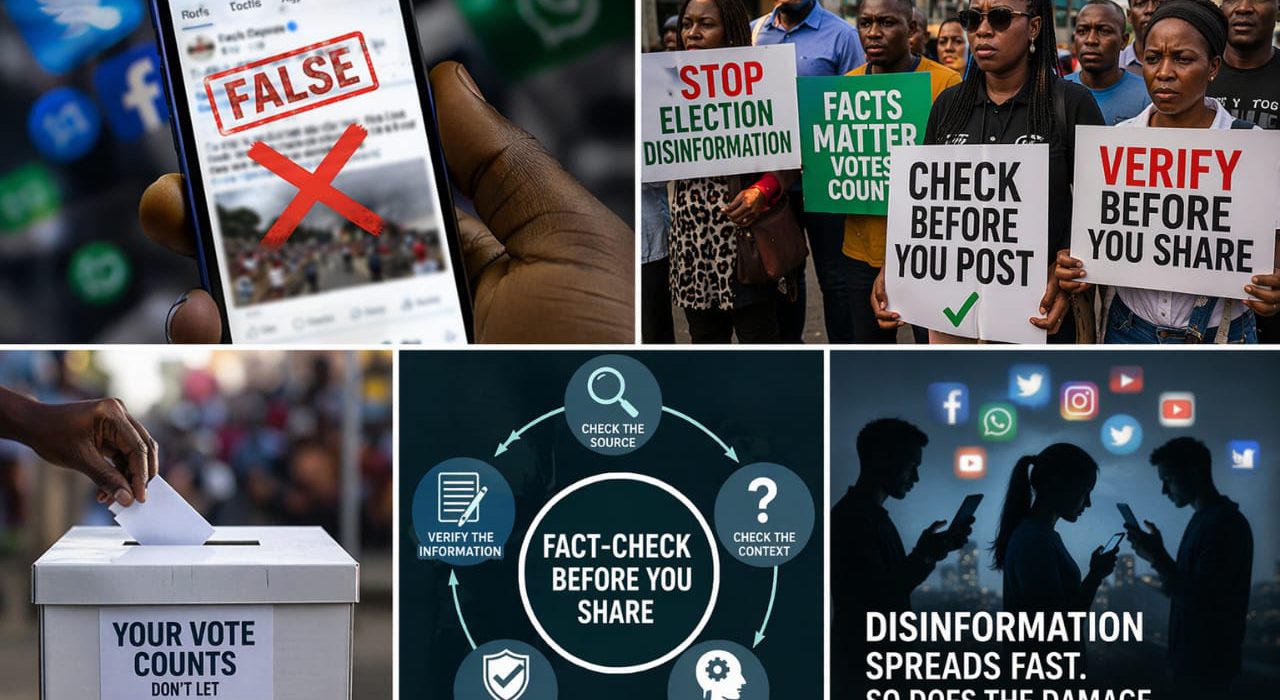
This is why citizens must rise to confront election disinformation head-on through the #CheckBeforeYouPost campaign.

False narratives are already circulating widely across social media and even finding their way into some mainstream platforms. As citizens, we become complicit when we fail to challenge falsehood or worse, when we help spread it by forwarding unverified information.
Disinformation poses a serious threat to the health of democracy. Every citizen has a responsibility to defend the integrity of the electoral process by intentionally practicing fact-checking, questioning suspicious claims, and verifying the credibility of sources before sharing any information.
Those who fabricate and spread falsehood during election periods do so to distract the public, manipulate perception, and ultimately undermine democracy for selfish gain.
The fight against election disinformation is not for institutions alone, it is a civic duty for all. To secure credible elections and responsive leadership, Nigerians must commit to becoming more responsible digital citizens. Before you post, forward, or share any political message, pause to ask: Is it true? Is it verified? Is the source credible?
Democracy depends not only on votes cast at the ballot box, but also on the integrity of information shared in the public space.
Join the movement. Protect democracy. Fight disinformation.
Always Check. Always Verify. Always Question.
This article is produced as part of the FIAP/EPSG Project, an initiative focused on countering misinformation, disinformation, and malinformation in the lead-up to Nigeria’s 2027 general elections.
It aims to promote credible information, strengthen public trust in the media, and support democratic processes by encouraging accuracy, accountability, and responsible communication.
Short Link:
Leave feedback about this